Why Crossing Time Zones Disrupts Your Circadian Rhythm
Your circadian rhythm, the internal 24-hour clock governed by the brain's suprachiasmatic nucleus, is calibrated primarily by light exposure and is deeply resistant to sudden change. When you fly across multiple time zones, your body's internal clock is still running on the schedule of your departure city, even though the sun, meals, and social cues around you now
say otherwise. This mismatch is jet lag: melatonin release, cortisol peaks, and core body
temperature cycles are all still timed for a location you've left behind.
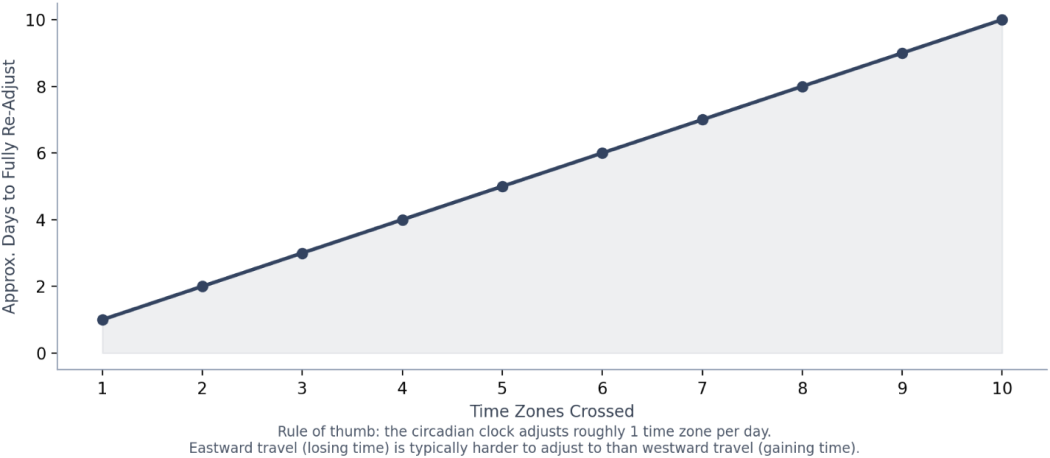
As a general rule, the circadian system adjusts by roughly one time zone per day, meaning a flight crossing six time zones can take the better part of a week to fully resolve. Eastward travel, which requires falling asleep earlier than your body wants to, is typically harder to adjust to than westward travel, since it's generally easier for the body to stay up later than to fall asleep earlier.