Environmental Controls for Quality Sleep: Engineering Your Bedroom for Deep Rest

Most sleep advice focuses on behavior – what time to go to bed, what not to eat, how much screen time to avoid. But your bedroom itself is doing just as much work. Air quality, humidity, temperature, light, scent, and even the weight of your blanket all send signals to your nervous system about whether it’s safe to power down. In the right environment, sleep becomes easier by default. Let’s walk through the environmental levers that shape sleep quality and the practical tools that help you control them.

Explore Content

Air Quality and Humidity: The Invisible Sleep Variable

Air is easy to overlook because you can't see it, but it's one of the most direct physiological inputs into sleep. Airborne allergens such as dust mites, pet dander, and pollen trigger nasal congestion and micro-arousals that fragment sleep without you ever fully waking up. A HEPA air purifier running in the bedroom overnight reduces circulating allergen particles, which is particularly valuable for people with asthma or seasonal allergies whose symptoms tend to worsen at night when lying flat.

Airflow itself also matters. A quiet fan does double duty: it keeps air moving so the space around your body doesn't get stagnant and warm, and its low-level white noise can mask sudden environmental sounds that would otherwise cause brief awakenings.

Humidity is the piece most people never think to measure, yet it directly affects breathing comfort and skin hydration overnight. The Environmental Protection Agency and most sleep researchers point to a target range of 30–50% relative humidity, with many experts converging on roughly 50% as the ceiling for comfort and health. Outside that range, the consequences are climate-specific:

  • In warm, humid climates, air above 50–60% humidity encourages dust mite and mold growth and can leave the air feeling "heavy," making it harder for the body to cool itself through evaporation. A dehumidifier pulls excess moisture out of the air, restoring the body's ability to regulate temperature through sweat evaporation.
  • In dry climates or heated winter air, humidity below 30% dries out nasal passages and skin, often causing morning congestion, sore throat, or static-related discomfort. A cool mist humidifier adds moisture back into the air without raising room temperature, which a warm mist humidifier would work against.


Since core body temperature needs to drop for sleep onset and to stay low through the night, a mattress or topper that actively manages heat removes overheating as one of the most common causes of middle-of-the-night waking.


Cooling Technology in Mattresses and Toppers

Even with the room at the right temperature, the mattress you're lying directly on top of can trap heat against your body all night. Traditional memory foam is notorious for this because the density that makes it supportive also makes it insulating, holding body heat rather than dissipating it.

Modern cooling technologies address this in a few distinct ways:

  • Gel-infused foam distributes and disperses heat away from contact points rather than absorbing it
  • Phase-change material (PCM) covers actively absorbs excess heat when your body runs warm and releases it back when you cool, acting like a thermal buffer
  • Breathable, open-cell foam structures allow greater airflow through the mattress itself instead of trapping warm air near the surface
  • Copper- or graphite-infused layers conduct heat away from the body faster than standard foam
  • Coil/hybrid constructions naturally allow more air circulation than solid all-foam beds


Since core body temperature needs to drop for sleep onset and to stay low through the night, a mattress or topper that actively manages heat removes overheating as one of the most common causes of middle-of-the-night waking.

Natural Bedding and Reduced Chemical Exposure

Many conventional mattresses, pillows, and synthetic bedding materials are treated with flame retardants, formaldehyde-based resins, and other volatile organic compounds (VOCs) that can off-gas over time, a process most noticeable as that "new mattress smell." While regulatory bodies set exposure limits, health-conscious sleepers increasingly opt for materials that minimize this exposure altogether:

  • Non-toxic, certified mattresses (look for certifications like GOTS, GOLS, or CertiPUR-US) avoid many of the flame-retardant chemicals and synthetic foams used in conventional options
  • Organic cotton and flax linen sheets are grown and processed without the synthetic pesticides and chemical finishing agents used on conventional cotton, and linen in particular is naturally moisture-wicking and breathable, reinforcing the temperature-regulation goals above
  • Down comforters offer natural insulation with excellent breathability compared to many synthetic fills, helping regulate warmth without trapping humidity against the skin


Beyond chemical exposure, natural fiber bedding tends to be more breathable and temperature-regulating than synthetic alternatives, which reinforces rather than competing with the cooling strategies already covered.

Light Exposure: The Most Powerful Circadian Signal

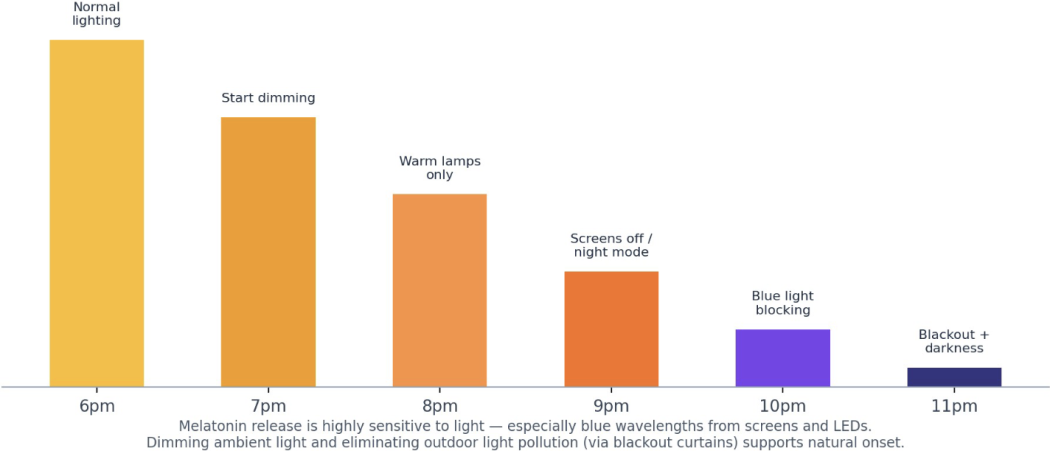
Of every environmental input, light has the single strongest effect on the body's sleep-wake system. Light, particularly blue wavelengths in the 460–480nm range emitted heavily by phone screens, laptops, and standard LED bulbs, suppresses melatonin production by signaling to the suprachiasmatic nucleus that it's still daytime. Exposure to bright or blue-heavy light in the hour or two before bed measurably delays sleep onset and shifts the circadian clock later.

The fix isn't total darkness starting at sundown; it's a gradual dimming that mirrors what the
body evolved to expect from a setting sun:


Wind down your lighting after sundown

Beyond your own lighting choices, outdoor light pollution such as streetlights, passing car headlights, early dawn light in summer, can cause repeated brief awakenings throughout the night, even if you don't remember them in the morning. Blackout curtains combined with French return rods eliminate this variable entirely, which is especially valuable for anyone in an urban environment, on a rotating shift schedule, or living somewhere with long summer daylight hours.

Aromatherapy: Scent as a Nervous System Cue

Scent has a uniquely direct route to the brain's emotional and arousal centers, bypassing the more analytical processing that other senses go through. This is part of why certain scents have a measurable calming effect:

  • Lavender has been studied for its effect on the autonomic nervous system, with research suggesting it can reduce heart rate and blood pressure and increase the proportion of deep, slow-wave sleep in some study populations
  • Chamomile has similarly been associated in small studies with reduced anxiety-related movement during sleep, potentially through its effect on GABA receptor activity, the same inhibitory neurotransmitter pathway targeted by many anti-anxiety medications


Used consistently, a calming scent introduced only at bedtime can also become a learned cue, a Pavlovian signal that primes the nervous system to downshift the moment it's detected.

Weighted Blankets and Deep Pressure Stimulation

Weighted blankets work through a mechanism called deep pressure stimulation (DPS), firm, evenly distributed pressure across the body that has been shown in occupational therapy and sleep research to reduce physiological arousal. The proposed mechanism is a shift in autonomic balance: DPS appears to lower activity in the sympathetic ("fight or flight") nervous system while increasing parasympathetic ("rest and digest") activity, in some studies correlating with modest reductions in cortisol and increases in serotonin and melatonin.

Practically, most sleep researchers recommend a blanket weighing roughly 10% of body weight for a noticeable calming effect without restricting movement or overheating.

Bringing It All Together

All of these environmental controls work together to have a compounding effect. A cool, well-humidified room with clean air, a heat-dissipating mattress, low-toxin natural bedding, dim warm lighting, true outdoor darkness, and a calming scent all point the nervous system toward the same outcome: a body that's been given every physiological permission slip it needs to fully rest. For recommended solutions, please visit our Rest Standards page.

Discover more

Sleep While Traveling

Travel is one of the fastest ways to throw sleep….

The Sleep Environment:

Most sleep advice focuses on behavior – what time to….

The Science of Rest

Sleep is one of the most biologically active processes your….