Sleep While Traveling: Managing Jet Lag, Cabin Comfort, and the Rise of Sleep Tourism

Travel is one of the fastest ways to throw sleep completely off course. New time zones, unfamiliar beds, cabin pressure, and disrupted routines all work against the very systems that normally keep sleep on autopilot. But travel doesn’t have to mean a week of exhaustion. Understanding why jet lag happens and having the right tools and options on hand can make the difference between arriving depleted and arriving ready.

Explore Content

Why Crossing Time Zones Disrupts Your Circadian Rhythm

Your circadian rhythm, the internal 24-hour clock governed by the brain's suprachiasmatic nucleus, is calibrated primarily by light exposure and is deeply resistant to sudden change. When you fly across multiple time zones, your body's internal clock is still running on the schedule of your departure city, even though the sun, meals, and social cues around you now
say otherwise. This mismatch is jet lag: melatonin release, cortisol peaks, and core body
temperature cycles are all still timed for a location you've left behind.

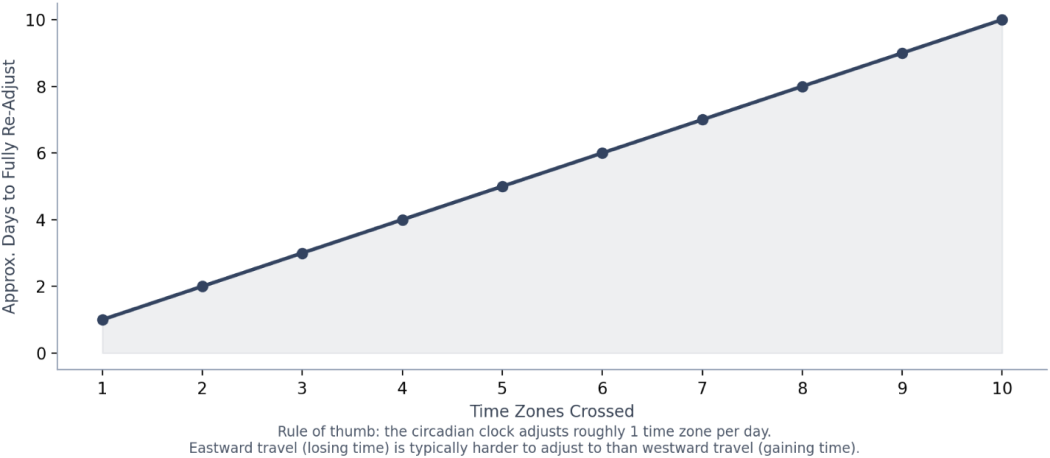
As a general rule, the circadian system adjusts by roughly one time zone per day, meaning a flight crossing six time zones can take the better part of a week to fully resolve. Eastward travel, which requires falling asleep earlier than your body wants to, is typically harder to adjust to than westward travel, since it's generally easier for the body to stay up later than to fall asleep earlier.

Jet Lag Mitigation Tools

Beyond adjusting light exposure and meal timing at your destination, a handful of low-tech tools consistently make a measurable difference in actual sleep quality while in transit and in unfamiliar rooms:

  • Travel pillows provide neck support that allows for genuine sleep in an upright seated position, rather than the fragmented dozing most travelers settle for
  • Earplugs block engine noise, cabin chatter, and unfamiliar hotel sounds — all common sources of the brief awakenings that fragment sleep without travelers realizing it
  • Eye masks block ambient cabin lighting and hotel light leaks, reinforcing the "it's night" signal to the brain regardless of what's happening outside the window
  • Lightweight pajamas help prevent overheating, which is a common issue given how much cabin and hotel room temperatures can vary from a traveler's normal sleep environment
  • Socks (compression socks in particular) support circulation on long-haul flights, reducing the restlessness and leg discomfort that can interrupt in-flight sleep

Traveling With a Silk Pillowcase

One frequently overlooked travel item is a silk pillowcase. Hotel linens are typically laundered in industrial facilities using high-heat cycles and strong detergents, which can leave chemical residue that triggers mild allergic or irritant reactions such as skin redness, itchiness, or respiratory irritation for sensitive travelers. Packing a personal silk pillowcase avoids direct contact with those residues while also offering a smoother, less friction-prone surface than standard cotton, which can help reduce facial irritation on longer trips. It's a small, lightweight addition to a travel bag that directly targets a source of disrupted sleep many travelers never trace back to their pillowcase.

Sleep at 35,000 feet: Lie-Flat Beds, Sleep Pods, and Private Suites

Airlines have increasingly recognized that in-flight sleep quality is a genuine competitive differentiator on long-haul routes, and the hard product in premium cabins has evolved accordingly. Lie-flat seats, which recline into a fully horizontal bed rather than a reclined angle, have become the standard expectation in business class on long-haul international flights, offered by carriers ranging from Delta to Lufthansa to Singapore Airlines. Several airlines have pushed further into enclosed private suites with sliding doors, ambient lighting, and dedicated storage, designed to function less like a seat and more like a compact private room in the sky.

Even economy cabins are beginning to see sleep-focused innovation. Air New Zealand's Skynest offers bookable lie-flat sleep pods, a small bunk-style area separate from standard seating where economy passengers can reserve a multi-hour sleep session on long-haul routes, while its Skycouch product converts a row of standard economy seats into a flat sleeping surface for one or more travelers.

The Rise of Sleep Tourism

As chronic sleep deprivation has become more widely recognized as a public health issue, a growing segment of the travel industry has emerged specifically around helping travelers sleep better: sleep tourism. Rather than treating sleep as incidental to a trip, sleep tourism makes rest the primary purpose of travel, and hotels and resorts around the world have built entire programs around it.

These programs typically combine several reinforcing elements:

  • Sleep-optimized rooms with blackout curtains, acoustic soundproofing, and precise temperature control, often adjustable via bedside touch panels
  • Smart beds that track sleep quality throughout the night and adjust firmness, temperature, or pressure points in real time
  • On-site sleep consultations with sleep doctors or specialists who help build a personalized program for the stay
  • Circadian-supportive programming, including morning light exposure, timed meals, and reduced evening light and screen exposure
  • Recovery treatments such as guided breathwork, aromatherapy, sound healing, and spa therapies are designed to lower physiological arousal before bed


Properties from Six Senses resorts to city hotels like Equinox Hotel New York and the Park Hyatt New York have introduced dedicated sleep suites, often developed in consultation with sleep researchers, while destinations known for a naturally slower pace like Kyoto's traditional ryokans, Santorini, and wellness retreats in Big Sur have become popular sleep-tourism destinations in their own right. The category has grown quickly enough that industry analysts now estimate the broader global sleep tourism sector is worth hundreds of billions of dollars, reflecting just how many travelers are now willing to plan a trip around rest rather than sightseeing.

How to Enjoy Your Trip

Travel will always put some strain on sleep. New time zones and unfamiliar environments are unavoidable parts of getting somewhere. But the gap between an exhausting trip and a restorative one often comes down to a handful of deliberate choices: giving your circadian rhythm time to adjust, packing a few well-chosen comfort tools, seeking out airlines and accommodations that take sleep seriously, and, when possible, letting rest itself be part of the destination. For recommended solutions, please visit our Rest Standards page.

Discover more

Sleep While Traveling

Travel is one of the fastest ways to throw sleep….

The Sleep Environment:

Most sleep advice focuses on behavior – what time to….

The Science of Rest

Sleep is one of the most biologically active processes your….